Apollo
Apollo 5
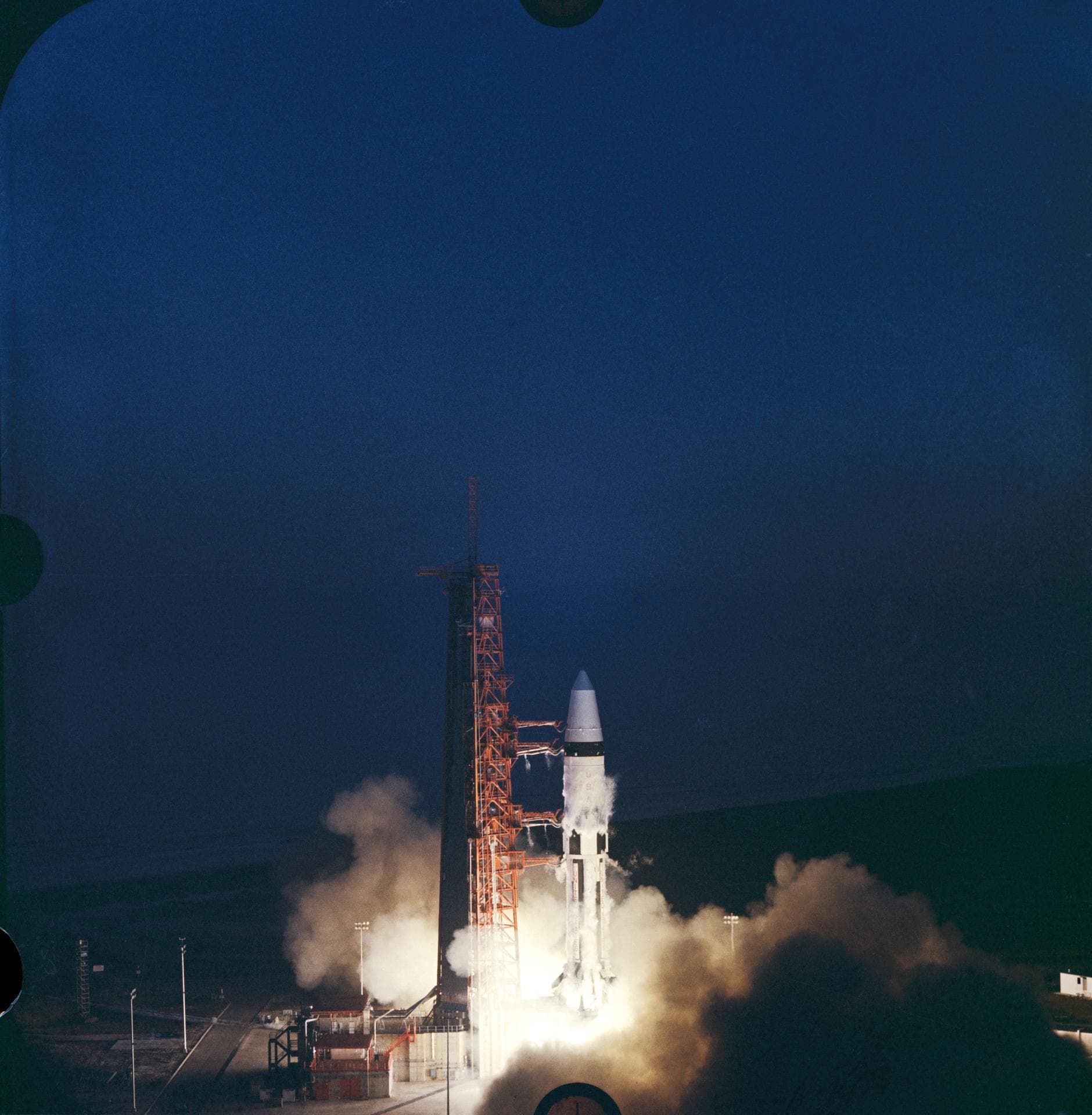
Apollo 5 was the first flight of NASA's Lunar Module, the extraordinary spacecraft designed exclusively to land astronauts on the Moon. The uncrewed mission tested both the descent and ascent engines, validated the Lunar Module's guidance systems, and proved that the vehicle could perform the complex maneuvers required for future lunar landings.
Launch
January 22, 1968
Duration
11 hours, 10 minutes
Crew
Uncrewed
Mission record
Apollo archive entry · Successful
Mission Overview
The mission
Apollo 5 was the first flight of NASA's Lunar Module, the extraordinary spacecraft designed exclusively to land astronauts on the Moon. The uncrewed mission tested both the descent and ascent engines, validated the Lunar Module's guidance systems, and proved that the vehicle could perform the complex maneuvers required for future lunar landings.
In Depth
The Full Story
Apollo 5 was one of the most important engineering milestones of the Apollo Program, despite often being overshadowed by the famous crewed missions that followed. Launched on January 22, 1968, Apollo 5 carried Lunar Module LM-1 into Earth orbit aboard a Saturn IB rocket from Launch Complex 37B at Kennedy Space Center.
Unlike the Command Module, which was designed to travel from Earth to the Moon and back again, the Lunar Module had an entirely different purpose. It was the first spacecraft ever built solely for operation in the vacuum of space. It had no aerodynamic shape, no heat shield, and no capability to survive atmospheric flight. Every pound of its design served one goal: safely landing astronauts on the Moon and returning them to lunar orbit.
Apollo 5 represented the Lunar Module's first opportunity to prove itself beyond ground testing. Engineers needed to verify that both propulsion systems would ignite correctly, that the spacecraft's guidance computer could control powered flight, and that every major subsystem could function in orbit.
One of the mission's primary objectives was testing the Descent Propulsion System. Unlike previous rocket engines, it had to throttle smoothly during powered flight, allowing future astronauts to slow their descent toward the lunar surface. Apollo 5 also tested the Ascent Propulsion System, the engine that would one day launch astronauts from the Moon for rendezvous with the Command Module.
During the mission, onboard guidance software terminated part of a planned engine sequence after detecting conditions outside expected parameters. Rather than ending the flight, NASA's flight controllers quickly developed an alternate testing sequence known as the "fire-in-the-hole" maneuver. This unique procedure intentionally ignited the ascent engine while the descent stage remained attached, simulating one of the most demanding emergency situations that astronauts could face during a lunar landing.
The revised test successfully demonstrated the performance of the ascent engine and confirmed the Lunar Module's propulsion systems could safely complete their critical functions. Although the mission did not execute every planned maneuver exactly as originally designed, Apollo 5 achieved its primary engineering objectives and provided engineers with the confidence needed to continue the Apollo flight schedule.
The knowledge gained during Apollo 5 directly influenced improvements made before Apollo 9, where astronauts would fly the Lunar Module for the first time, and ultimately Apollo 11, where a later version of the spacecraft successfully carried Neil Armstrong and Buzz Aldrin to the surface of the Moon.
Apollo 5 proved that humanity's first true Moon lander could fly.
Mission Details
Official Designation
Apollo 5
Mission Type
Uncrewed Lunar Module Flight Test
Launch Date
January 22, 1968
Launch Time
5:48 p.m. EST
Launch Site
Launch Complex 37B
Launch Vehicle
Saturn IB SA-204
Spacecraft
Lunar Module LM-1
Manufacturer
Grumman Aircraft Engineering Corporation
Crew
Uncrewed
Mission Duration
11 hours, 10 minutes
Orbit
Low Earth Orbit
Mission Result
All primary engineering objectives achieved
Historic First
First flight of the Lunar Module
Primary Payload
Lunar Module LM-1
Primary Goal
Validate Lunar Module propulsion systems
Major Engine Tested
Descent Propulsion System
Second Engine Tested
Ascent Propulsion System
Emergency Demonstration
Fire-in-the-hole maneuver
Destination
Earth Orbit
Program
Apollo
Next Lunar Module Flight
Apollo 9
Mission by the Numbers
Mission Statistics
Mission Type
Uncrewed Lunar Module Flight Test
Launch Vehicle
Saturn IB SA-204
Crew
0 astronauts
Status
Successful
Mission Goals
Mission objectives
- 01
Conduct the first orbital flight of the Apollo Lunar Module.
- 02
Verify operation of the Lunar Module Descent Propulsion System.
- 03
Verify operation of the Lunar Module Ascent Propulsion System.
- 04
Demonstrate engine ignition in the vacuum of space.
- 05
Evaluate throttle capability of the descent engine.
- 06
Test Lunar Module guidance, navigation, and control systems.
- 07
Validate spacecraft communications systems.
- 08
Evaluate electrical power generation and distribution.
- 09
Measure structural loads experienced during powered flight.
- 10
Verify thermal-control performance in orbit.
- 11
Demonstrate emergency ascent capability using the fire-in-the-hole maneuver.
- 12
Collect engineering data for Apollo 9 and future lunar landing missions.
- 13
Validate overall Lunar Module performance during independent orbital flight.
Fascinating Details
Did You Know?
Key did you know? recorded for this mission.
Apollo 5 was the first spacecraft designed specifically to land on another world ever flown in space.
Unlike the Command Module, the Lunar Module was never intended to fly through Earth's atmosphere.
LM-1 had no heat shield because it would never return to Earth.
The Lunar Module's unusual shape was entirely driven by function rather than aerodynamics.
Apollo 5 carried no astronauts because engineers wanted to prove the spacecraft before anyone flew aboard it.
The mission's most famous accomplishment was the 'fire-in-the-hole' test.
The ascent engine was designed to start instantly after astronauts left the lunar surface.
Apollo 5 proved both Lunar Module engines could operate in space.
NASA controllers rewrote portions of the flight plan during the mission after the automatic abort.
The revised test profile still accomplished the mission's most critical engineering goals.
LM-1 never flew again after Apollo 5.
Later Lunar Modules incorporated improvements based directly on Apollo 5 data.
Every astronaut who landed on the Moon depended on engineering lessons learned during Apollo 5.
Without Apollo 5, Apollo 9 could not have safely tested the Lunar Module with astronauts aboard.
Apollo 5 remains one of the least-known but most important missions of the Apollo Program.
Mission Timeline
1967
LM-1 Completes Manufacturing
Grumman Aircraft Engineering Corporation completed Lunar Module LM-1, the first flight-worthy Lunar Module built for spaceflight testing.
Late 1967
Integrated Testing
NASA engineers completed extensive electrical, propulsion, and systems testing before preparing LM-1 for launch.
January 1968
Launch Preparations
Apollo 5 and its Saturn IB launch vehicle completed final countdown demonstrations and preflight inspections at Kennedy Space Center.
January 22, 1968 · 5:48 p.m. EST
Apollo 5 Launches
A Saturn IB rocket lifted Lunar Module LM-1 into Earth orbit from Launch Complex 37B.
Shortly After Launch
Orbit Achieved
The Saturn IB successfully placed the Lunar Module into its planned parking orbit, beginning the first in-space evaluation of the vehicle.
Initial Orbit
Spacecraft Checkout
Mission controllers verified electrical systems, communications, guidance hardware, and spacecraft health before beginning propulsion testing.
First Propulsion Test
Descent Engine Ignition
The Descent Propulsion System fired successfully, marking the first operation of the engine designed to land astronauts on the Moon.
Engine Test Sequence
Automatic Abort
The onboard guidance system terminated part of the planned burn sequence after detecting conditions outside expected limits, requiring mission controllers to revise the remaining test profile.
Revised Flight Plan
Alternate Test Approved
Rather than ending the mission early, NASA flight controllers rapidly developed an alternate sequence that would still satisfy the mission's most important engineering objectives.
Mid-Mission
Fire-in-the-Hole Demonstration
Apollo 5 successfully executed the famous 'fire-in-the-hole' maneuver, igniting the ascent engine before the descent stage had completely separated. The test simulated one of the most demanding emergency situations astronauts might encounter during a lunar landing.
Ascent Propulsion Test
Ascent Engine Performs Successfully
The Lunar Module's ascent engine operated successfully, proving the propulsion system responsible for lifting astronauts off the Moon could perform as designed.
Spacecraft Evaluation
Systems Continue Operating
Engineers continued collecting engineering data from guidance systems, communications equipment, electrical systems, thermal control hardware, and structural sensors throughout the remainder of the flight.
End of Mission
Mission Complete
Apollo 5 concluded after approximately eleven hours in orbit, having successfully demonstrated the Lunar Module's critical propulsion systems and validating the spacecraft for future crewed testing.
Postflight Analysis
Engineering Review
Detailed analysis confirmed that Apollo 5 had successfully achieved its primary engineering objectives despite modifications made during the mission.
1969
Legacy Proven
The engineering lessons learned during Apollo 5 directly contributed to the success of Apollo 9, Apollo 10, and ultimately Apollo 11's historic lunar landing.
Mission Legacy
Legacy
Apollo 5 transformed the Lunar Module from an experimental engineering project into a proven spacecraft capable of operating in space.
Before January 1968, every Lunar Module existed only as a collection of ground tests, simulations, and engineering predictions. Engineers believed the vehicle could land on the Moon, but no one had ever watched its propulsion systems operate in orbit.
The mission demonstrated that the Lunar Module's unique design worked. Its descent engine ignited successfully, its ascent engine proved capable of firing in space, and NASA's guidance systems successfully controlled the vehicle throughout powered flight.
Perhaps more importantly, Apollo 5 demonstrated the strength of NASA's mission operations team. When the original engine sequence was interrupted by the guidance system, controllers quickly adapted, creating an alternate flight plan that still achieved the mission's essential objectives.
The data gathered during Apollo 5 directly influenced improvements incorporated into later Lunar Modules. Those refinements appeared during Apollo 9's crewed Earth-orbit test, Apollo 10's lunar dress rehearsal, and finally Apollo 11's historic landing at Tranquility Base.
Apollo 5 rarely receives the recognition given to crewed Apollo missions, yet its success quietly removed one of the largest engineering uncertainties standing between humanity and the Moon.
For the first time, the spacecraft that would eventually carry twelve astronauts to the lunar surface had proven it could fly.
Mission Photo Archive
Related Stories
Apollo
The Moon Photos That Still Feel Impossible
Before social media, astronauts brought back images that changed how humanity saw itself forever.
Read Article →
Artemis
Why Artemis Will Change Lunar Exploration
NASA's return to the Moon is designed to become more sustainable, more international, and more ambitious than Apollo.
Read Article →
ISS
Life 250 Miles Above Earth
Inside the daily routine of astronauts living and working aboard the International Space Station.
Read Article →